Essay: Commerce Leaves the Web - Three Months In

In February 2026, I wrote that this would be the year commerce leaves the web. I meant it literally: the websites you browse to in your browser aren't where transactions happen anymore. They're moving into the AI assistant.
At the time, that prediction came with significant caveats. MCP, the Model Context Protocol had been around since November 2024. It was machine-to-machine only. Text-based. No UI. But three weeks before I wrote that piece, something changed. On January 26, MCP Apps launched. It's the extension that lets MCP servers deliver interactive UI elements directly into Claude's / ChatGPT,s chat window.
Three months later, it's not a prediction anymore. It's observation.
What changed in those three months is the pace of adoption. We're seeing hundreds of MCP connectors emerge like StubHub, Booking.com, and many others building UI experiences that render directly in the chat. You ask for something, and instead of opening a tab or copying a URL, the interface appears right there. You can browse, interact, see details all without leaving the conversation.
The first objection I kept hearing was predictable: "But companies will lose their brand. They'll lose control of the experience." That concern made sense in a text-only world. If all you could do was expose your API as text, enterprises had no way to shape how they appeared to users. The AI assistant owned the experience.
MCP Apps changed that math entirely. Now enterprises can embed their full UI their branding, their design language, their control directly into the assistant. StubHub is a good example. You see their interface, their layout, their visual identity. The experience is theirs, not the assistant's. That removes the fundamental objection.
But there's a second shift happening that's equally important, and it's less visible. It's about context.
When I'm planning a trip to Melbourne, I don't need to re-explain myself to Claude. It already knows I'm an NFL fan. It knows I prefer certain types of experiences when I travel because I've documented those preferences in markdown files that live in my Obsidian vault files that Claude can read.
So when I ask for things to do in Melbourne, Claude doesn't just dump every event at me. It filters through that context. It surfaces NFL games in Melbourne because it understands my interests, not because I typed them out again. On the web, that's impossible. I'd have to overload my search query with all my preferences, or I'd get random results and have to manually filter.
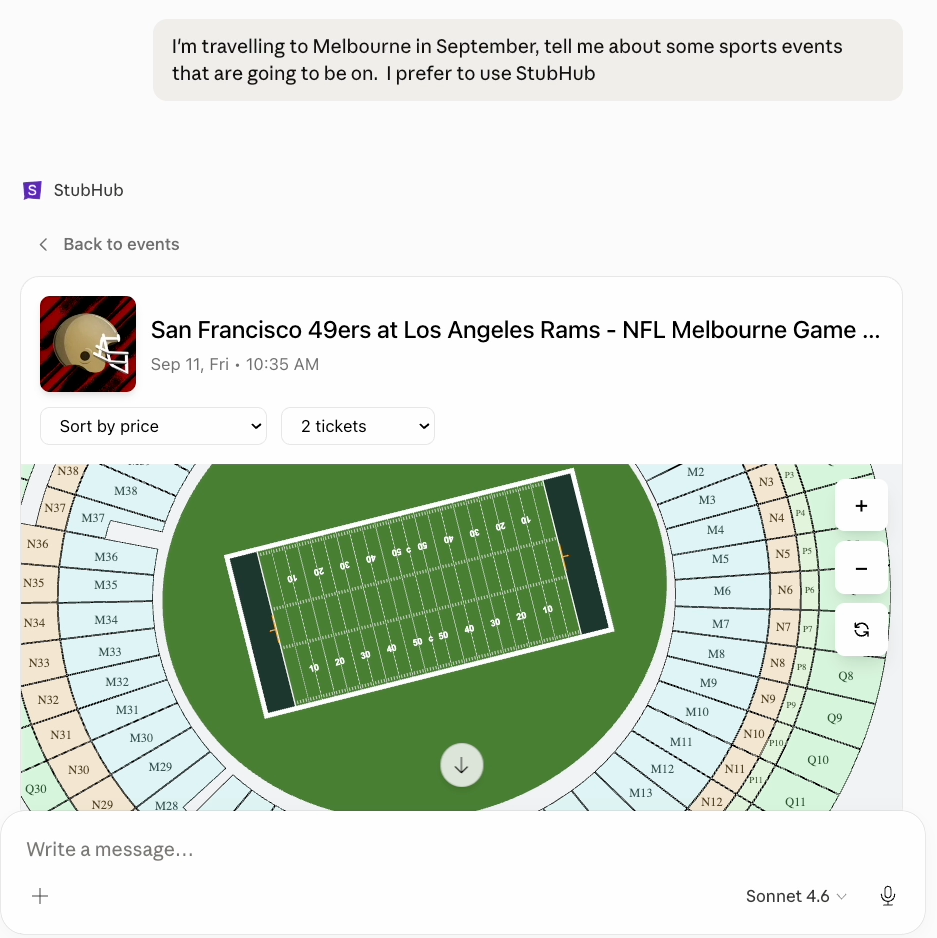
The AI does the filtering for me because it already knows me.That's the real unlock that most people haven't grasped yet. It's not just that UIs are now native to the assistant. It's that the assistant understands you across time and context. You're not context-switching between search and browse and purchase. You're staying in a single conversation where the AI has already reasoned about what matters to you.
Right now, this is early days. When you find something you want a ticket, a hotel you still have to pop out to the web to complete the purchase. StubHub's UI renders in Claude, but the checkout happens on their website. That's not a flaw; it's just where we are. The protocol is there. The UI layer is there. The payment integration will follow.
What's interesting is the direction. Commerce isn't leaving the web because the web is bad. It's leaving because staying in context is better. And for the first time, enterprises can control that experience without handing it over to the AI.