Essay: MCP Servers: What They Actually Do (And Why They Matter)

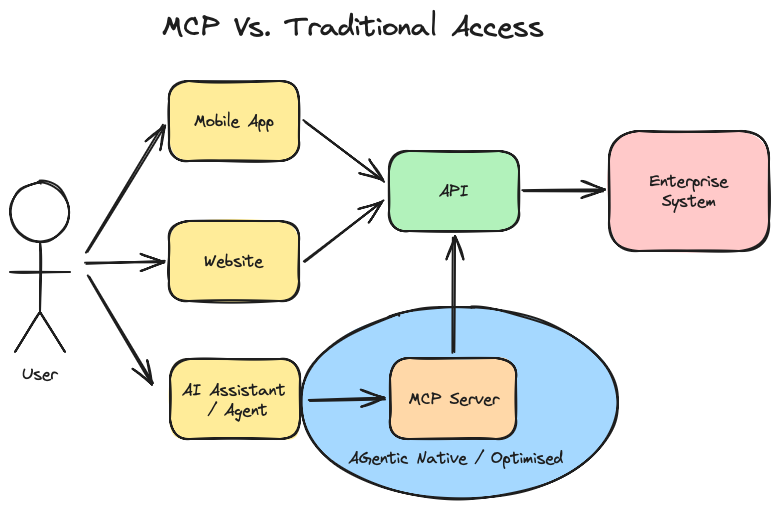
Here's the thing about enterprise software: it's built in layers. You've got systems that hold data. You've got interfaces that let people access that data. For decades, those interfaces were either desktop applications or websites. Both work the same way, they (typically) wrap APIs in a user experience.
Now there's a third layer emerging...accelerating : AI assistants. And this is where it gets interesting.
When you talk to an AI assistant and ask it to do something, look up an order, check an inventory, process a request, something has to translate that request into action. The AI needs to know what it can do, how to do it, and when to do it. That's where MCP servers come in.
MCP stands for Model Context Protocol. It's a translator. It sits between your enterprise systems / SaaS... and your AI assistant. It exposes what your systems can do in a way the AI can understand and act on.
The key difference is discovery. When an AI assistant connects to an MCP server, the first thing it does is ask: "What can you do for me?" The server responds with a catalog, here are my tools (functionality), here's what each one does, here's what information I need to run them and will give back. The AI reads that catalog and understands its options before it needs to take action. With REST APIs, you have to know the endpoints beforehand and hardcode (even if AI assisted) them into the system. With MCP, the capabilities are advertised and discoverable. The AI finds them, understands them, and decides how to use them in real time. Kinda the UDDI for AI.
Here's why that matters: REST APIs were designed for applications talking to applications. They work fine, great even. AI can technically figure out how to use them. But they're not optimized for how AI actually thinks.
MCP is different. It's built for agent reasoning. When you expose a tool through MCP, you're telling the AI: here's what this does, here's when you might use it, here's what you'll get back. The AI reads that, decides which tool to invoke, sends the request, and gets the response back into its reasoning. It's native to how large language models work.
Think of it like this: a REST API is like giving someone a phone book and expecting them to figure out who to call. MCP is like saying, "Here are your contacts, here's their number, here's what they do." The AI doesn't have to guess.
Now, there's conversation in the industry about whether MCP itself—the specific protocol, is what matters, or whether it's just the idea that matters. Fair point. Maybe in five years there's something better. But here's what's important right now: simplicity doesn't mean unimportance. IP addresses are simple. They're foundational to the entire internet. MCP is the same. It's the first widely adopted, AI-native way for enterprises to expose their capabilities to agents. It might not be the last protocol, but right now, it's what we have.
Once you can reliably expose what your systems can do in a way AI actually understands, everything else becomes possible. Faster decisions. Better integrations. Less manual work. Systems actually talking to each other the way they were always supposed to.
That's what MCP does.