Essay: Phased Alignment

If there is one thing that I’m constantly encouraging my team to do, it’s to get into alignment with each other. You know the pattern: close the door, everyone has their say, debate the issue properly, and when we leave the room we’ve all signed up to the decision and don’t break ranks.
Sounds great. However, it doesn’t always play out that way. Even when the team is full of capable professionals with good intent, alignment sometimes can’t be achieved. So where to from there?
Rather than treating this as failure, I like to treat it as something that needs structure.
Alignment doesn’t always fail because people aren’t trying hard enough — sometimes it fails because the decision is hard, the context is complex, or time is working against us. This is where I use a Phased Alignment.
What is Phased Alignment?
Phased Alignment is a simple construct that defines clear phases for decision making alignment, ranging from fully team-led decisions through to leadership owned decisions when alignment can’t be reached.
Importantly, the existence of later phases doesn’t reduce empowerment, it creates psychological safety. Teams know they can debate hard, disagree openly, and explore options without risking paralysis or ambiguity about how a decision will ultimately be made. The decision still needs to be made. There’s no backing away from that. What changes across phases is who owns the decision.
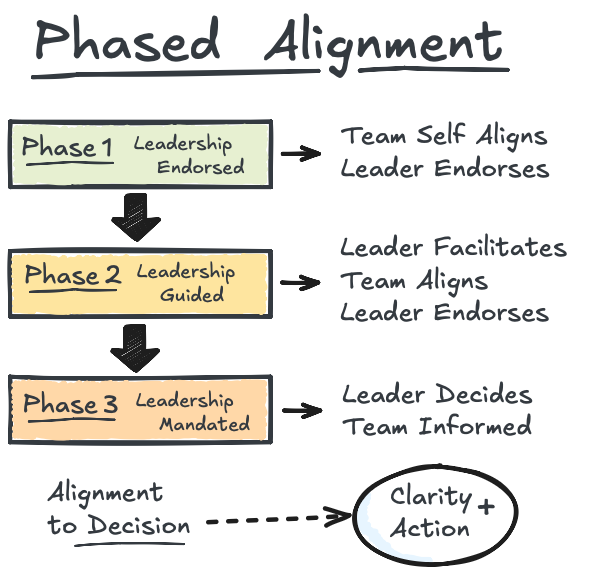
Phase 1 – Leadership Endorsed Decisions
Teams operate independently and self-guided, working through the issue until alignment is achieved. Leadership’s role here is to endorse the outcome. This is the best outcome. Most decisions in a high-functioning team land here. What’s the decision? Everyone aligned? Awesome. Job done. This is the good stuff.
Sometimes it isn’t that straightforward. It might be:
- A genuinely difficult or ambiguous problem
- Strong, well-formed views shaped by past experience
- Uneven experience levels in the room
- Or simply a decision with high stakes and limited information
Whatever the reason, sometimes a team can’t reach alignment on its own and that’s not unusual. When that happens, the decision moves into a new phase.
Phase 2 – Leadership Guided Decisions
Phase 2 is where leadership becomes more active in guiding the conversation. This doesn’t mean the team is troublesome it usually means they’re stuck, looping, or struggling to converge.
Leadership Guided Decisions typically involve:
- Re-workshopping with leadership actively present
- Clarifying outcomes and constraints
- Reinforcing the importance of alignment
- Helping the team move from divergence to convergence
Tools like Six Thinking Hats can be useful here. So can reassurance — particularly the reminder that many decisions are reversible, that we can test and learn, and that revisiting a decision later is often both possible and healthy. A useful signal that you’re in Phase 2 is when discussion continues, but progress stalls.
In effective teams, Phase 2 is usually enough. Alignment is reached, commitment is restored, and the team moves forward together.
On occasion, even with guidance, alignment still doesn’t emerge. This isn’t about blame. It’s a signal that the cost of delay is now higher than the cost of disagreement. At that point, leadership needs to step in.
Phase 3 – Leadership Mandated Decisions
This is not the destination we aim for. The team has had space to align independently, then support to align with guidance, but alignment still hasn’t been reached. At this point, decision ownership shifts fully to leadership.
Let’s be honest — something hasn’t worked as well as we’d hoped. But this isn’t a punishment or a power move. A decision is required, and leadership is accountable for ensuring it happens.
Mandated decisions exist to protect momentum, manage risk, and create clarity — not to shut down debate or diminish trust.
Conclusion
I’ve found the Phased Alignment framework to be genuinely helpful, and teams tend to respond well to it.
It allows me to clearly state two things at the same time:
- I am committed to empowering teams to make decisions I can endorse
- When alignment can’t be reached, I am willing to step in so the organisation can move forward
Most of the time, teams operate comfortably in Leadership Endorsed Decisions. Occasionally they move into Leadership Guided Decisions, and that’s healthy. Sometimes teams even ask to start in Phase 2 to get extra horsepower and that’s great too.
And yes, sometimes we land in Leadership Mandated Decisions. That’s not failure it’s reality.
Let’s always aim for Leadership Endorsed Decisions. They usually deliver the strongest commitment, the best outcomes, and the highest trust.
Phased Alignment doesn’t guarantee perfect decisions — it guarantees clarity, momentum, and shared understanding of how decisions are made.